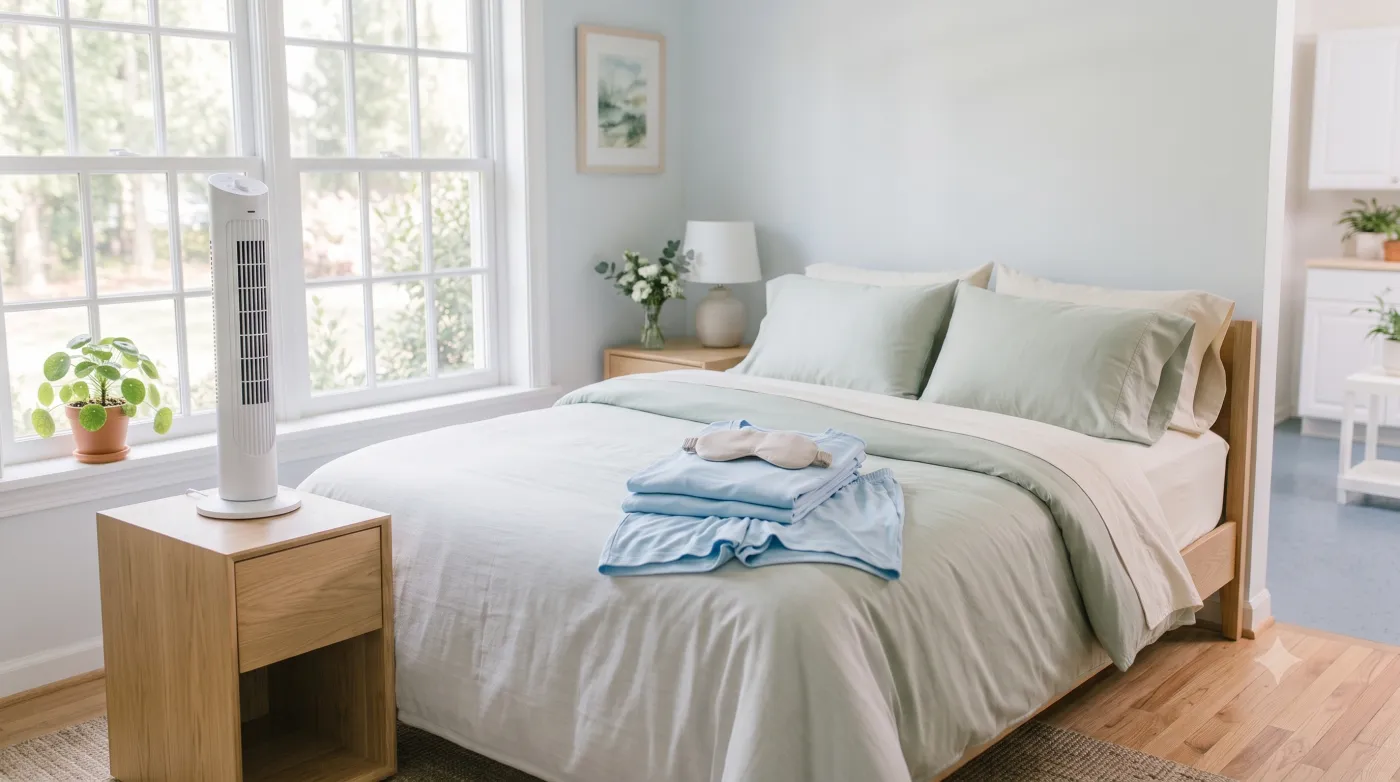
The best bedside and personal fans for hot flashes
When the heat hits at 3am, nothing works faster than moving air. Here are the fans actually worth keeping within arm's reach.
8 minute read
Some links on this page are affiliate links. We earn a commission from qualifying purchases — it doesn't change our picks. We only point you to things we'd recommend to a friend.
The short version
- Top pick: the Dreo Nomad One tower fan — quiet enough on low to sleep through, loud enough on high to break a flash.
- A fan is the fastest hot-flash relief you can buy. Moving air evaporates sweat off your skin the instant a flash hits, so the heat breaks in seconds instead of minutes.
- Keep two: one plug-in fan for the bed, and one small rechargeable handheld for flashes that catch you in the car, the office, or a crowded room.
Our top pick, in one line
If you buy one thing today, get the Dreo Nomad One. Its low setting sits inside the range that won't wake you and the high setting is still livable — so you can run it all night and turn it up the instant a flash starts. Point it at your face and chest. It's the closest thing to an off switch for a night sweat.
Why a fan is the fastest hot-flash tool you own
Here's the plain-English version. During perimenopause your body's thermostat gets twitchy. A hot flash — or a night sweat when it hits at night — floods you with heat and sweat, then leaves you clammy and wide awake.
A fan works because of one simple thing: evaporation. When air moves across damp skin, it carries the heat away and the sweat dries. That's why a flash that would linger for two or three miserable minutes breaks in seconds the moment you've got air on your face and chest. No pill, no cooling gel, no cold drink cools you that fast.
A fan won't stop the flash from starting — for that, read how to stop hot flashes. But it's the best tool you've got for shortening the flash once it's underway, and at night that's often the difference between waking up fully and drifting back to sleep. Pair it with the other fixes in night sweats and sleep.
How we chose these
We didn't get sent free fans and we're not ranking by star count. These are researched picks based on what genuinely helps during a flash, at night and on the go. Here's what we looked for:
- Quietness. For a bedside fan this matters more than anything. A loud fan trades a hot flash for a noise problem. We favored fans with a genuine low, whisper-level setting.
- Airflow. A fan that can't actually move air is decoration. It needs enough push to reach your face and chest from the nightstand.
- Size and placement. Bedside real estate is small. A tall, narrow footprint or a clip-on beats a wide floor fan you have to step around.
- Adjustability. You want to aim it exactly where the heat is, and tilt it so it's not blasting your partner.
- Rechargeable vs. plug-in. Plug-in fans run all night without dying. Rechargeable fans go anywhere. Each has a place — we picked for both.
- Value. You do not need to spend a fortune to move air. We flagged small, cheap options that punch above their price.
One honest note: "quiet" is the most oversold word in the fan aisle. A fan that's quiet on its lowest setting can roar on high — right when a flash makes you want high. We weighted our picks toward fans that stay livable even when you turn them up.
The two numbers that matter
Fans are the one product on this site with real, comparable specs printed on the box. Learn these two and you can ignore every adjective in the listing.
Decibels (dB) is loudness. For a bedroom you want the low setting between 25 and 45 dB — 25 is quieter than a whisper, 45 is about a library. Above 45 on low and it will wake you.
CFM is cubic feet per minute — how much air actually moves. Around 1,000 CFM handles a small bedroom. A big open room wants 3,000 or more. A fan can be beautifully quiet and still useless if the CFM is tiny.
The trap is that these fight each other. Quiet usually means less air. What you're looking for is the model with the best CFM at a sleep-safe dB, not the quietest fan or the strongest fan.
Two warnings on the numbers. First, brands don't all publish the same one — Vornado gives CFM, Dreo gives wind speed in feet per second, and the two aren't convertible, so you often can't compare across brands directly. Second, advertised decibel figures come from a silent test chamber at a fixed distance. Treat them as a way to rank models against each other, not as a promise about what you'll hear from a nightstand.
| Fan | Type | Noise on low | Airflow | Best for |
|---|---|---|---|---|
| Dreo Nomad OneOur pick | 36″ tower, 90° oscillation | 20 dB claimed; ~35 dB measured | 25 ft/s top wind speed | All-night bedside air |
| Vornado 533 / 533DC | Air circulator | Quiet on low; DC model quietest | Circulates a whole small room | Stuffy bedrooms |
| Dreo Desk Fan | Desk / personal | ~20 dB — near-inaudible | Personal-space only | Daytime flashes at a desk |
| Honeywell HT-900 TurboForce | Turbo, aimable | ~45 dB, steady broadband | High for the price | Doubling as white noise |
Where a claimed and a measured figure differ, both are shown. Airflow isn't comparable across these brands — Vornado publishes CFM, Dreo publishes wind speed — so treat that column as a rough sense of scale rather than a ranking.
The picks
1. Dreo Nomad One — best overall for sleep
Best for: anyone who wants steady, all-night air without waking the house.
Why it works: it's a 36-inch tower, so the footprint is tall and narrow and it fits beside a nightstand instead of eating it. It has four speeds including a dedicated Sleep mode, 90-degree oscillation, and an 8-hour timer — and around $70 it's not an expensive experiment.
On the noise, honestly: Dreo advertises 20 dB at its lowest speed. Independent testing tends to land nearer 35 dB, with the top speed somewhere in the high 40s. Both can be true — manufacturers measure in a silent chamber at a set distance, and your nightstand isn't one. Either way it sits inside the sleep-safe range on low, which is what matters. Just don't expect literal silence.
The con: the top speed is audible, and if you share a bed with a light sleeper they will notice when you turn it up mid-flash. Dreo publishes wind speed (25 ft/s) rather than CFM, so you can't directly compare its airflow against a Vornado. And oscillation spreads the air — lock it in place if you want the stream on you.
2. Vornado 533 — best whole-room airflow
Best for: hot sleepers whose bedroom goes stuffy, not just hot.
Why it works: a Vornado isn't aimed at you — it's a circulator, built to push a column of air that bounces off the far wall and turns over the whole room. Stuffy, still air makes night sweats worse because there's nothing to carry the heat away from your skin. The 533 is the compact one, and the Energy Smart 533DC version runs quieter still thanks to its DC motor and tilts smoothly enough to aim at the ceiling.
The con: circulating a room is slower relief than a stream pointed at your chest. If you want a flash broken in ten seconds, that's the Nomad's job. Ideally you own both — this one running low all night, the tower for the moment it hits.
3. Dreo Desk Fan — best value personal fan
Best for: daytime flashes at a desk, and finding out whether a personal fan helps you before spending real money.
Why it works: at around 20 dB on low it's genuinely one of the quietest fans you can buy — quiet enough that you feel the air before you hear the fan, and quiet enough to run through a video call without anyone noticing. It plugs in at your desk and tilts up at your face when a flash builds.
The con: it cools the space right in front of it and not much more. Past a couple of feet the push falls off fast. This is a personal fan, not a room fan, and it's priced accordingly.
4. Honeywell HT-900 TurboForce — best if you want white noise too
Best for: people who already sleep with a sound machine, or who wake at every creak in the house.
Why it works: the HT-900 sits around 45 dB on its lowest setting — the top of the sleep-safe range — but the character of that sound is what earns it a spot. It's unusually consistent broadband noise, meaning an even hiss across frequencies rather than a whine or a pulse. That's the profile that masks other sounds well, so it doubles as a white-noise machine. It's also aimable and cheap, and it moves a lot of air for the money.
The con: 45 dB is the loudest low setting here, so if silence is what you need, buy the Nomad instead. This one is for people who sleep better with sound.
5. And one for your bag
We're not naming a specific handheld here, because the category churns constantly and today's best-seller is gone in six months. But get one. A flash that catches you in a meeting, a car, or a restaurant is a different kind of miserable than one at home, and a folding rechargeable handheld turns it into a non-event.
What to look for: a stated runtime of at least four hours on low, USB-C charging so it uses the cable you already carry, and a body that folds flat or stands on its own so it can sit on a desk. Skip anything with a built-in mister — they leak in bags.
Why a fan beats almost everything else on this site
Sweating doesn't cool you. Evaporating does. Sweat sitting on your skin in still air does nothing but make you damp — the cooling only happens when the moisture actually leaves. That's the whole reason a flash in a stuffy room feels endless while the same flash near an open window passes quickly.
A fan is the only thing you can buy that speeds up evaporation directly. Bedding helps heat escape; sleepwear moves sweat off your skin; a fan finishes the job by carrying it away. It's also the only one that works in seconds rather than gradually, which is why it's the cheapest high-impact purchase on this whole site — and why the fan is the thing to buy first if you're only buying one.
Frequently asked questions
How loud is too loud for sleep?
Use 45 dB as your ceiling for the low setting. Below 25 dB is quieter than a whisper, 45 is roughly a quiet library, and past that it will pull you out of light sleep. The Dreo Nomad One sits near 35 on low; the Honeywell HT-900 sits near 45, which is the edge.
But the number isn't the whole story — the character of the sound matters just as much. Steady, even hiss disappears into the background and can mask other noise. A whine, a rattle, or a fan that pulses as it oscillates will keep catching your attention at the same decibel level. And watch the spread between low and high: a fan that's silent on low but roars on high is a bad buy, because high is exactly what you'll want mid-flash.
Rechargeable or plug-in — which should I get?
Both, honestly, because they do different jobs. A plug-in fan by the bed runs all night without dying, which is what you want for reliable overnight air. A rechargeable clip-on or handheld goes where a cord can't — the couch, the car, the office, a friend's spare room. If you only buy one, make it the plug-in bedside fan; add a small rechargeable one the first time a flash catches you away from home. More on the whole sleep setup in night sweats and sleep.
Do bed-cooling fan systems actually work?
The systems that blow air under or through the sheets do help some people, because they attack the heat right at the mattress instead of the room. But they cost a lot more than a good bedside fan, they can be fiddly to set up, and the fan unit itself makes noise you'll be sleeping next to. For most people, a quiet bedside fan pointed at the face and chest does most of the job for a fraction of the price. If a plain fan isn't enough, a bed-cooling system is a reasonable next step — but try the simple, cheap fix first. And pair either one with a cooler head: see our best cooling pillows for night sweats.
A fan is the fastest, cheapest hot-flash tool you can own — moving air breaks a flash in seconds because it speeds up evaporation, and evaporation is what actually cools you. Start with the Dreo Nomad One on the nightstand, aimed at your face and chest. If your room goes stuffy rather than just hot, add a Vornado 533 to turn the air over. If you sleep better with sound, the Honeywell HT-900 does both jobs for less. And keep a folding rechargeable handheld in your bag for flashes that catch you out. Then work on the flashes themselves in how to stop hot flashes, and fix the rest of your sleep setup with night sweats and sleep and a cooling pillow.