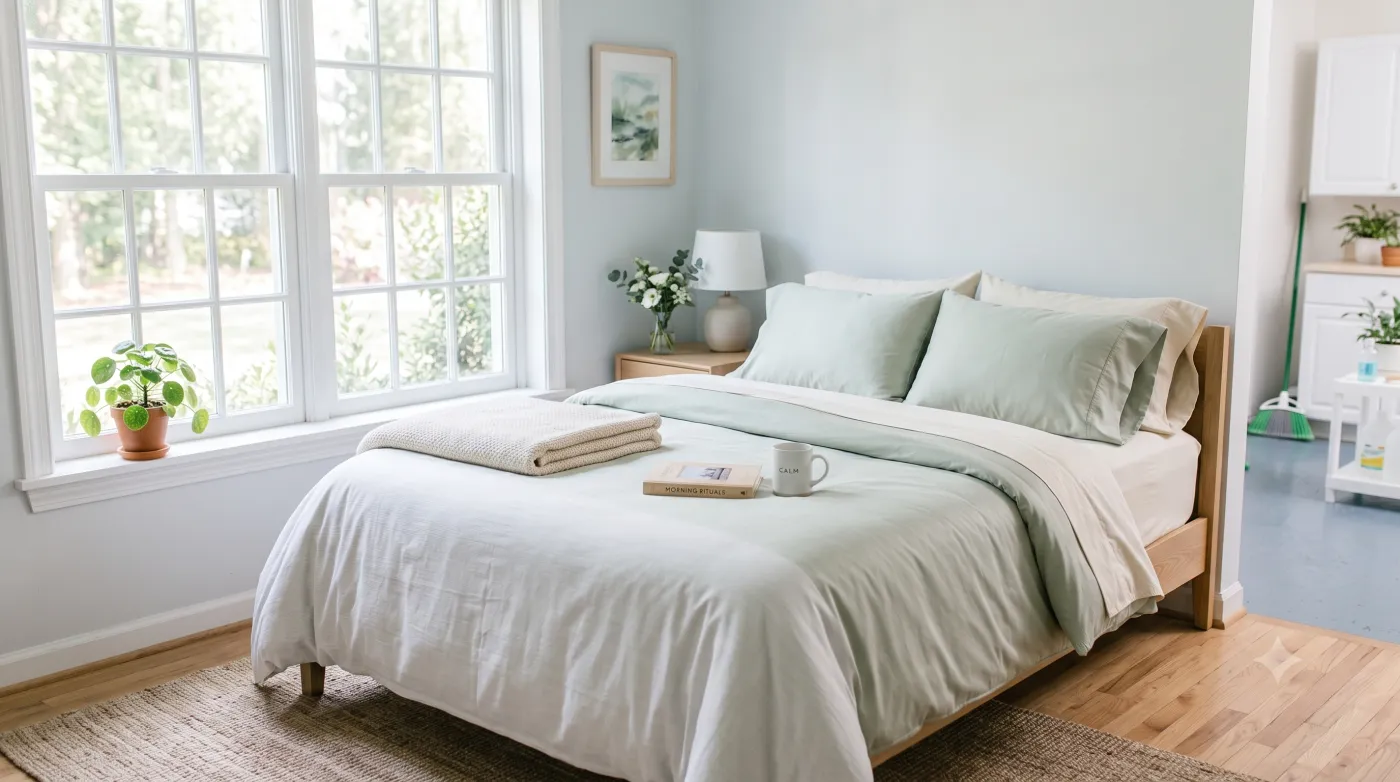
The best temperature-regulating blankets for menopause
Perimenopause swings both ways — burning hot one minute, kicking the covers off, then suddenly chilled. You don't want a "cooling" blanket. You want one that regulates.
8 minute read
Some links on this page are affiliate links. We earn a commission from qualifying purchases — it doesn't change our picks. We only point you to things we'd recommend to a friend.
The short version
- Top pick: the Slumber Cloud Lightweight Comforter — Outlast phase-change fill absorbs heat during a flash and releases it back when you cool. That two-way behavior is the whole game.
- A blanket can't stop a hot flash, but the wrong one — heavy, fleecy, heat-trapping — turns a small flash into a soaked, wide-awake 3am.
- Skip the word "cooling" on the label. Look for breathability, moisture-wicking, and light weight — that's what actually keeps you comfortable both ways.
Our top pick, in one line
If you buy one thing today, get the Slumber Cloud Lightweight Comforter. It's the only pick here with Outlast fill — a material originally developed for NASA that banks your body heat when you flash and hands it back when you cool. That's the exact two-way behavior a hot-then-cold night needs, and it's the difference between a blanket that picks a side and one that follows you.
Why menopause needs a temperature-regulating blanket, not a "cooling" one
Here's the plain-English version. During perimenopause your body's thermostat gets twitchy. A hot flash at night — a night sweat — floods you with heat and sweat. But then it passes, the sweat evaporates, and suddenly you're cold. Same night, same person, opposite problem.
That's the trap with most "cooling" bedding. A blanket that's built to feel cold all night is great during the flash and miserable ten minutes later when you're shivering. And a plush, heavy fleece blanket does the reverse — cozy at first, then it holds every bit of heat against you and the next flash turns into a puddle.
What you actually want is a blanket that regulates: breathable enough to dump heat when you're hot, and lofted or lightly insulating enough to keep a little warmth when you cool down. A blanket can't stop the flash itself — for that, read how to stop hot flashes. But the right one means the temperature swing doesn't drag you all the way out of sleep. Pair it with the other fixes in night sweats and sleep.
How we chose these
We didn't get sent free blankets and we're not ranking by star count. These are researched picks based on what genuinely helps a hot-then-cold sleeper. Here's what we looked for:
- Breathability. An open weave or breathable fill lets heat escape during a flash instead of trapping it against you. This is the single most important thing.
- Moisture-wicking. Night sweats mean sweat. A blanket that pulls damp away from your skin keeps the cold-and-clammy phase from waking you.
- Weight. Lighter is usually better for hot flashes — heavy blankets hold heat. We flag the one exception below.
- Works both ways. Cool when you're hot, cozy when the chill hits. If it only does one, it's not the right blanket for this.
- Washability. You'll be washing it often. A machine-washable blanket that survives real laundry is non-negotiable.
- Value. You shouldn't need to spend a fortune to sleep comfortably through the swings.
One honest note: "cooling" is the most oversold word in the bedding aisle. A blanket that feels icy in the store warms up the second it's on you, and it does nothing for the chill that follows a flash. What actually works across a whole night is airflow plus the right amount of loft. We weighted our picks toward that, not toward the marketing.
Quick comparison
| Blanket | How it regulates | Shell / fill | Weight class | Best for |
|---|---|---|---|---|
| Slumber Cloud LightweightOur pick | Outlast phase-change fill banks heat, returns it as you cool | 300TC 100% cotton shell · 50% Outlast ClimaDry + 50% polyester fill | Light / all-season | The full hot-then-cold swing |
| Buffy Cloud | Airflow — Buffy's lab testing puts it 32% above cotton bedding | 300TC lyocell sateen shell · 100% recycled PET fill | Light | Natural-fiber shell, allergy-prone sleepers |
| Topcee Cool-Touch Throw | Cool-to-touch surface (Q-Max 0.5) pulls heat off skin fast | Mica-nylon face, polyester back | Very light throw | Heavy sweats on a budget |
| Yana Cooling Bamboo | Wicking lyocell cover over breathable down-alternative loft | Lyocell cover · bamboo-derived + down-alt fill | Mid | Wanting loft without the heat trap |
| Hush Iced 2.0 | Wicking bamboo cover pulls heat off; weight for calm | 100% viscose-bamboo cover · polyester fill | Weighted (15 / 25 / 30 lb) | Anxiety wakeups — only if you don't overheat |
Q-Max is the industry number for how cool a fabric feels on first touch. Anything at or above 0.2 can legally be sold as "cool touch," which is why the label means so little — 0.4 and up is where you actually feel it. It measures the first few seconds of contact, not the whole night.
The picks
1. Slumber Cloud Lightweight Comforter — best overall for temperature swings
Best for: anyone who runs hot and gets the post-flash chills — which is most of us.
Why it regulates temp: the fill is half Outlast ClimaDry, a phase-change material built from tiny beads that melt as they take on your body heat and re-solidify as they give it back. In plain English: when the flash hits, the beads soak up heat instead of letting it sit against you. When the flash passes and you'd normally start shivering, they hand that stored heat back. The cotton shell keeps air moving on top of it. Nothing else in this list works in both directions on its own.
The con: the beads hold a finite amount of heat — on a bad night with back-to-back flashes, they fill up and you're left with a normal lightweight comforter. It smooths the swings, it doesn't erase them. It also costs more than the throws below.
2. Buffy Cloud — best breathable natural fiber
Best for: people who want the fluffy comforter feeling without the heat-trap of a heavy duvet, and who'd rather sleep under plant fiber than polyester.
Why it regulates temp: the shell is a 300-thread-count eucalyptus-derived lyocell sateen, and Buffy's own lab testing puts its airflow 32% above cotton-based bedding. More airflow means heat leaves instead of pooling, and lyocell moves moisture well, so the clammy phase after a flash is shorter. It's OEKO-TEX Standard 100 Class 1 certified and machine washable — cold wash, low heat or air fluff.
Worth knowing: only the shell is lyocell. The fill is 100% recycled PET — polyester, essentially. That's not a knock on it (the recycled fill is GRS-certified and it's what keeps the price sane), but if you were buying this believing it was plant fiber all the way through, it isn't.
The con: it breathes, but it doesn't actively bank and return heat the way the Slumber Cloud does. If your problem is the chill after the flash more than the flash itself, the Slumber Cloud is the better buy.
3. Topcee Cool-Touch Throw — best for heavy night sweats on a budget
Best for: sleepers whose flashes leave the sheets genuinely damp, and who want to spend under $30 to find out if a cooling layer helps at all.
Why it regulates temp: the mica-nylon face is rated Q-Max 0.5, which is high — that's a surface that genuinely pulls heat off your skin the moment you touch it, not a marketing claim at the 0.2 floor. It's thin and dries fast, so the cold-and-clammy phase after a flash passes quickly. Use it as the top layer you kick off, not as your whole blanket.
The con: the cool feeling is real but short. Once the fabric matches your body temperature it stops being cold, and it has almost no insulating loft, so it does nothing for the chills. This is a one-direction blanket. It's on this list because at throw prices it's a cheap way to handle the sweaty half of the night.
4. Yana Cooling Bamboo Blanket — best middle ground
Best for: people who want real loft and cozy weight, but have been burned by a comforter that cooked them.
Why it regulates temp: it splits the difference — a cool-to-the-touch lyocell cover for the flash, over a fill that blends bamboo-derived strips with down-alternative fibers for gentle warmth when you cool. You get some of the Slumber Cloud's two-way behavior and some of the Buffy's breathability, without committing fully to either.
The con: splitting the difference means it's not the best at either job. If you know which half of the night is your real problem, buy the specialist instead.
5. Hush Iced 2.0 — best weighted option, with a real warning
Best for: people whose sleep problem is as much racing-mind and restlessness as it is heat — and who don't overheat easily.
Why it's here: the cover is 100% viscose-bamboo, which is genuinely cool-to-the-touch and wicks sweat rather than trapping it — the reason this is the weighted blanket least likely to cook you. It comes in 15, 25 and 30 lb weights. If pressure is what gets you to sleep, this is the cooling-first version to reach for.
The con — and please read this one: skip a weighted blanket entirely if you overheat easily. A cool bamboo cover helps, but weight always means less airflow, and the polyester fill still insulates — no weighted blanket truly regulates temperature. For a lot of women in menopause that's the wrong trade. If your nights are mostly flashes and sweats, buy the Slumber Cloud. A weighted blanket only earns its place if pressure helps you more than heat hurts you.
What the wrong blanket actually costs you
A heavy fleece or winter-weight duvet doesn't just make a flash worse — it changes what the flash does to your night. Heat that can't escape keeps your skin temperature elevated after the flash ends, so instead of drifting back down you surface all the way into full wakefulness. Then the sweat evaporates under a blanket that traps air, you go cold, and you're up again.
That's the real math: one blanket mistake can turn a 90-second flash into two separate wakeups. Over a week that's a meaningful amount of sleep, and it's the cheapest thing on this whole list to fix. You don't need to replace a mattress. You need to stop sleeping under something that holds heat.
Frequently asked questions
Do cooling blankets really work for hot flashes?
Sort of — with a big caveat. A breathable, moisture-wicking blanket won't stop a hot flash (that's a hormone thing), but it does let heat and sweat escape instead of trapping them against you, so the flash is less likely to wake you fully. Where marketing overpromises is the "stays icy all night" claim — nothing does. The real win is a blanket that breathes when you're hot and doesn't leave you shivering when you cool. Pair it with the fixes in how to stop hot flashes.
Are weighted blankets a bad idea during menopause?
Not always, but be honest with yourself. Weight calms a racing mind, which helps some women fall asleep faster — but weight also cuts airflow, and if you overheat easily that's the last thing you want. If your nights are mostly flashes and sweats, skip it and go lighter. If your nights are mostly anxiety and restlessness and you don't run hot, a breathable cotton-covered version can genuinely help. Choose for your actual problem, not the trend.
How do I handle a night that swings from hot to cold?
Layer. This is the single best trick for perimenopause bedding: instead of one heavy blanket, use a breathable base — the Slumber Cloud Lightweight Comforter or the Buffy Cloud — plus a thin top layer like the Topcee throw that you can kick off and pull back without fully waking. Add breathable sheets underneath, keep the room cooler, and you can ride the swing by adjusting one layer at a time. More on the whole setup in night sweats and sleep, and the surface you sleep on matters too — see our picks for cooling sheets and cooling pillows.
Is Outlast worth paying extra for?
If the chill after the flash is what wakes you, yes. That's the one problem no ordinary breathable blanket solves — breathability only helps in the hot direction. Phase-change fill is the only thing on this list that puts warmth back. If your nights are all heat and no shivering, save your money and buy the Buffy Cloud or a cheap cool-touch throw instead.
If menopause is swinging you from soaked to shivering in the same night, stop shopping for the coldest blanket and start shopping for the one that moves in both directions. Start with the Slumber Cloud Lightweight Comforter and a thin throw on top you can add or drop. If your nights are heat-only, the Buffy Cloud does the job for less. If pressure is what actually keeps you awake and you don't overheat, the Hush Iced 2.0 is worth a try — and if you do overheat, skip weighted blankets entirely. Then work on the flashes themselves in how to stop hot flashes, and finish the sleep setup with night sweats and sleep.